|
|
|
|
|
Coral Reef Destruction ...
|
|
|
Overuse and the spread of non-sustainable fishing practices (such as dynamite fishing and cyanide fishing) have caused a rapid decline in live coral cover on many of the world's coral reefs.
In some parts of the tropics, more than 50% of the coral reefs are reported to be severely damaged.
Many large reef tracts have been reduced to little more than vast fields of coral rubble.
|
|
 |
|
|
|
Coral reef demolished by blast fishing. © 2001 Michael D. Moore
|
|
|
|
|
... Ecological Collapse and Slow Recovery
|
|
|
 |
|
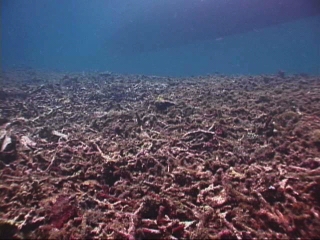
Large blasted areas are slow to recover because corals have difficulty establishing on loose or sandy substrate,
Lacking suitable habitat, reef fish quickly abandon a demolished reef, which initiates a long term decline in local fish populations.
Young corals struggling for a foothold are easily buried by shifting sediments, or smothered by carpets of algae and soft corals.
Marine ecology studies suggest that at least 50 years are required for the complete re-establishment of hard coral cover once it has been removed.
|
|
|
Blasted reef with algae overgrowth. © 2001 Helen E. Fox
|
|
|
|
|
|
Coral Reef Remediation
|
|
|
Protecting the health and productivity of coral reefs is in the economic interests of governments, beachfront hotels, dive operators, and local fishing communities. Good community-based management of reef resources is essential to the success of all coral reef conservation efforts.
However, where damage to reefs is severe, even well-managed reefs will take decades to reestablish by natural means.
EcoReefs offers ecologically-appropriate remediation technology to assist the recovery of damaged reefs.
Applications include:
- Creating new coral reefs in barren areas for snorkeling and diving.
- Remediating large reef tracts destroyed by extensive blast fishing to restock local fisheries.
- Repairing reefs damaged by storms, ship groundings, boat anchors, trampling, dredging or coral mining.
|
|
|
|
The Artificial Reef Myth
|
|
|
What about artificial reefs?
What do they actually accomplish in terms of coral reef remediation?
While artificial reefs made from ships, cars, tires, or concrete blocks are commonly installed in temperate sites to improve sportfishing and recreational diving, these methods are not appropriate for the remediation of coral reefs. They often utilize materials which are polluting or toxic, and tend to permanently structure the ecosystem without restoring reef framework. The structures primarily attract adult fish, which make important brood stocks easily fished out. Most artificial reefs don't provide the complex, fine-scale habitat needed by juvenile fish or the small herbivorous fish that keep reefs free of algae.
|
|
Conventional artificial reefs typically cover such a small area that they fail to make a significant impact on the reproduction rates of reef fish and hard corals. Furthermore, artificial reefs can be expensive and cumbersome to install, and often end up creating underwater eyesores of astonishing durability.
To many ecologists and conservationists, artificial reefs represent just another form of marine pollution with no ecological benefit. To many divemasters and hotel owners, artificial reefs are unattractive and a poor ecotourism investment.
|
|
 |
|
|
|
Conventional artificial reef in the making.
|
|
|
|
|
|
|
The EcoReefs™ Solution
|
|
|
The EcoReef™ (Pat. Pending) offers an ecologically appropriate means for restoring damaged coral reef ecosystems to pristine condition. The system was invented by an experienced marine scientist based on years of coral reef observations from all over the world, and was specifically designed to address the shortcomings of conventional artificial reefs.
The EcoReef™ creates an attractive temporary intervention which helps "jump start" the coral reef ecosystem by initiating the normal process of ecological succession from branching colonizing corals to a higher-diversity coral cover. Unlike conventional artificial reefs, it closely simulates the habitat naturally provided by large thickets of branching corals.
This is a completely different, innovative approach-- one with broad conservation and ecotourism appeal.
|
|
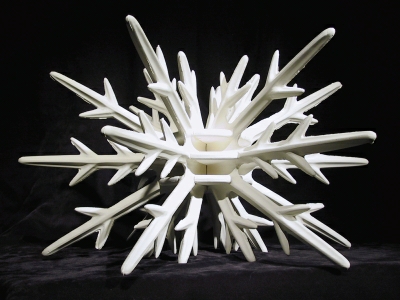 |
EcoReef™ Module
Features:
30 branches with spines
3 shaded settling plates
86cm (34") diameter
46cm (18") high
18 kg (40 lbs)
2:1 aspect ratio
Nontoxic, pH neutral ceramic
Free standing or anchored
Fast and easy installation
|
|
|
The EcoReef™ Ceramic Module. © 2001 Michael D. Moore
|
|
EcoReef™ modules have a spiny, branching design that simulates the growth habit of branching corals. When deployed in a large array, the modules create an attractive reef with abundant, dimensionally complex space for juvenile and herbivorous fish.
EcoReef™ modules also incorporate several shaded settling plates which are raised off of the bottom to protect young corals from soft coral and sand scour. The surface characteristics are chemically ideal for the recruitment of coralline algae and young coral.
Over time, individual modules are degraded by wave action and become incorporated into the reef sediment. Unburied fragments bearing live coral starts can contribute to the establishment of additional coral colonies. This simulates the natural fate of branching corals. By allowing for this process in the design, the modules can be replaced by a living coral cover within several years. Thus, little or no evidence of a human intervention is left behind.
EcoReefs™ provides an effective, appropriate intervention which can lead to a fully remediated coral reef ecosystem.
|
|
|
|
The Science of Coral Reef Remediation
|
|
|
Findings from recent ecological experiments show that fish and coral will repopulate even severely degraded coral reefs if certain basic requirements are met. These include good water quality, a stable structure that is raised off of the bottom, non-toxic shaded surfaces for coral settlement, and abundant living space for small fish (Fox, H., Pet, J., Dahuri, R., Caldwell, R. [in review] "Coral restoration after blast fishing in Indonesia" Proceedings, 9th International Coral Reef Symposium).
EcoReefs™ expands on these ecological principles by combining in the design a stable 2:1 aspect ratio, non-toxic materials, raised and shaded surfaces for coral recruits, and spatial complexity for fish -- plus the added benefits of being attractive underwater, non-permanent, and deployable over large areas.
|
|
 |
|
|
Rock pile experiments on blasted reefs. © 2001 Helen E. Fox
|
|
|
|
|
|
|
EcoReef Installations: Sized to Build Real Reefs
|
|
|
Because EcoReef™ modules are mass produced, it is now possible to make reefs which are large enough to have significant genetic impact on the recovery of reef fisheries.
|
|
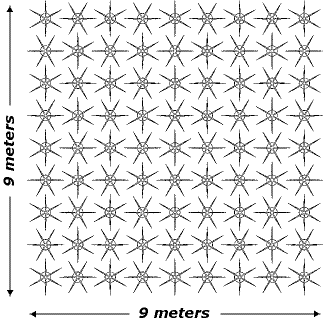
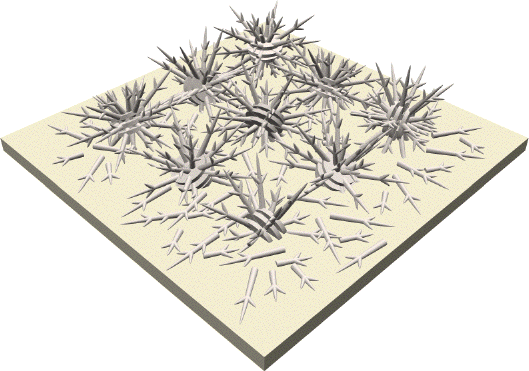
EcoReef™ modules are typically installed in a close-packed array to simulate a dense thicket of branching corals.
Reefs of all sizes can be created-- from small back-reef snorkeling attractions to those as large as a football field.
Prefabrication allows for a fast and easy deployment, with minimal diver support.
|
|
 |
|
|
Top view of a snorkeling reef created by EcoReef™ modules.
|
|
|
|
EcoReefs Underwater: Natural Look, Complex Fish Habitat
|
|
|
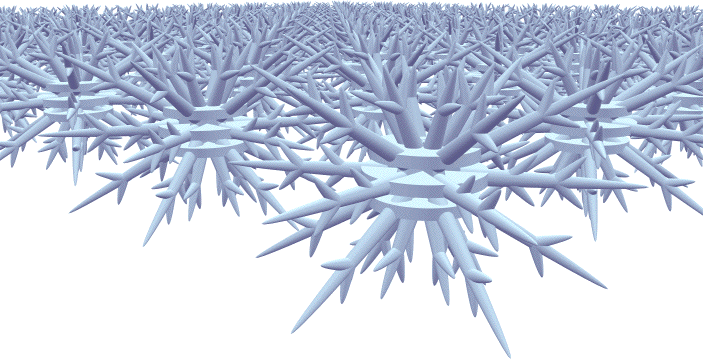
This rendering shows how the EcoReef™ appears underwater.
Note how well it simulates the appearance and spatial complexity typical of a thriving coral reef. Abundant habitat is provided for small fish (juveniles and herbivores), as well as many shaded settling surfaces for coral recruits. Small reef fish living in the EcoReef™ naturally keep algae and soft coral overgrowth under control, creating favorable conditions for rapid coral colonization.
|
|
 |
|
|
|
An EcoReef™ installation looks natural underwater and creates living space for small reef fish. © 2001 Michael D. Moore
|
|
|
|
|
|
|
|
EcoReefs Promote True Coral Reef Remediation
|
|
|
One of the major benefits of the EcoReefs™ system is that it is designed so the biological reef can replace the artificial reef over time, thus leaving little evidence of a human intervention.
Hard corals can cover and weld some modules together, while wave action will cause other modules to degrade and become incorporated into the reef sediment. Corals growing on scattered module fragments will have the opportunity start new colonies.
EcoReef™ installations have an expected lifespan of 7-15 years (depending on local conditions), a length of time sufficient for the biological reef to replace the artificial reef.
By virtue of its non-permanence underwater, the EcoReef™ enables the natural re-establishment of hard corals and contributes to returning a degraded reef to its original, pristine condition. This is far more desirable than permanently structuring a degraded reef by introducing long-lasting man-made objects of questionable ecological value.
|
|
|
 |
|
|
|
EcoReef™ modules degraded by wave action. © 2001 Michael D. Moore
|
|
|
|
EcoReefs Compared to Conventional Artificial Reefs
|
|
|
EcoReefs™ beats conventional artificial reef solutions in comparisons of potential ecological benefits, impact on fisheries and tourism, and ease and cost of deployment.
|
|
| Feature |
EcoReef™ |
Conventional Artificial Reef |
Is it compatible with ecotourism?
|
YES: Looks Natural Underwater
|
NO: Unsightly Underwater
|
Does it remediate the reef ecosystem?
|
YES: Can Be Replaced by Living Coral
|
NO: Permanent Structure
|
Does it help build coastal fisheries?
|
YES: Provides Habitat for Juvenile Fish
|
NO: Provides Habitat for Adult Fish
|
Does it minimize algae growth?
|
YES: Provides Habitat for Small Herbivores
|
NO: Provides Habitat for Adult Fish
|
Does it promote coral growth?
|
YES: pH Neutral Surface Chemistry and Shaded Plates Ideal for Coral Settlement
|
NO: Concrete (basic pH) or Metal (reactive) Surfaces Retard Coral Settlement
|
Is it ecologically significant?
|
YES: Covers Large Areas
|
NO: Localized Effects Only
|
Is it fast & easy to install?
|
YES: Prefabricated, Ready for Use
|
NO: On-Site Concrete Pouring or Heavy Lifting Required
|
Is it cost effective?
|
YES: Mass Produced, Low Cost per Unit Area Covered
|
NO: Hand Built, High Cost per Unit Area Covered
|
|
|
|
|
|
|
Contact EcoReefs Today for a Free Consultation
|
|
|
- How to create a coral reef as a new beachfront snorkeling and diving attraction...
- Rehabilitating damaged coral reefs in managed marine areas to increase tourism revenues....
- Restocking coastal reefs for subsistence fisheries ...
|
|
How to Contact EcoReefs™
by email:
[email protected]
by phone:
(415) 648-9725
by fax:
(520) 569-0458
by mail:
EcoReefs, 306 Chattanooga Street
San Francisco, CA 94114, USA
© 2001 EcoReefs™, USA. All rights reserved.
This site is protected by copyright, trademark, and patent laws under U.S. and international law.
No part of this site may be reproduced without the express permission of
Michael D. Moore, Ph.D., President, EcoReefs™
The EcoReefs™ site was first published on 22-Jun-2001.
Last Modified: Thursday, 26-Jul-2001 12:06:44 EDT
|
|
|
|
|
|
|
|
|
|
|
|
|
|
|
|
|
|