|
|
|
|
EcoReefs Demonstration Reef Site
Bunaken National Park, North Sulawesi, Indonesia
|
|
|
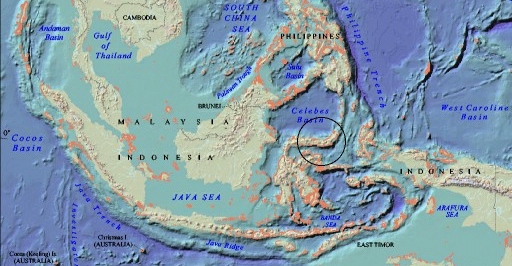
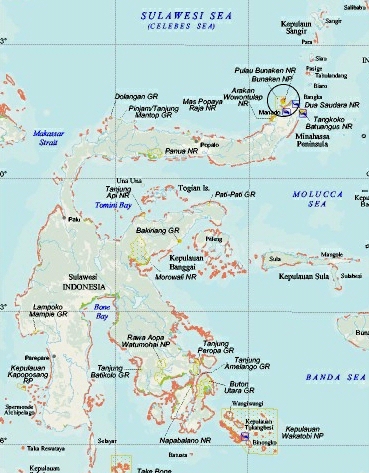
In October 2001, EcoReef® modules were deployed in Bunaken National Park (N. Sulawesi, Indonesia) to evaluate fish and coral colonization rates. Bunaken is one of the world's premier dive destinations, and has an active coral reef conservation community that includes dive operators, villagers, fishers, park rangers and marine police.
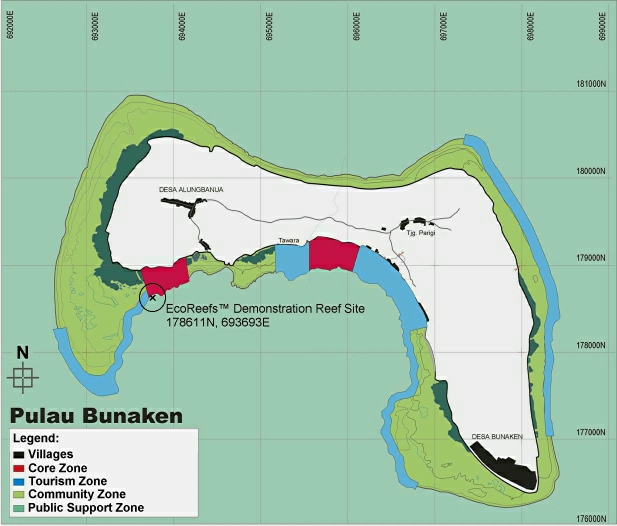
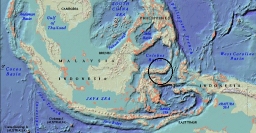
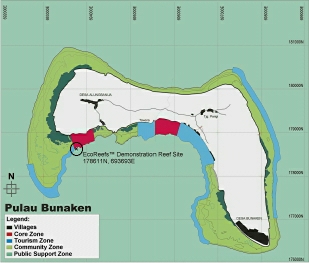
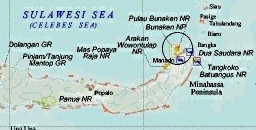
The study site lies within the west Core Conservation Zone on Pulau Bunaken (see map), an area where fishing and general diving are strictly prohibited. Though relatively protected from NW Monsoon swell, the site can be swept by strong currents. The site was extensively bombed 10-15 years ago and has large areas of loose rubble which show few signs of successful coral recuitment.
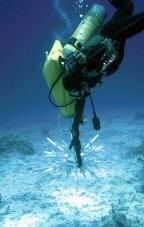
Seven modules were assembled on shore and deployed at 10m depth on the forereef slope. The modules were anchored using 2m lengths of rebar pounded into the reef sediment. Coral branch tips were wired to several modules to evaluate their transplantation potential. Fish and coral recruitment will be monitored every 2-4 weeks for the next 12 months.
Assisting in the deployment were staff from Froggies Divers, Officer John Kantaley and the Bunaken patrol team, and Alung Banoa villagers. Rebar anchors were kindly donated by Christiane Muller of Froggies Divers. Ecological monitoring will be conducted by Dr. Mark Erdmann, Marine Protected Areas Specialist with NRM/EPIQ (USAID).
|
|
|
 |
 |
|
 |
|
|
Site maps (click to see larger images)
|
|
|
|
|
Photo Gallery
|
|
|
|
|
|
|
|
|
|
|
|
|
|
 |
|
 |
|
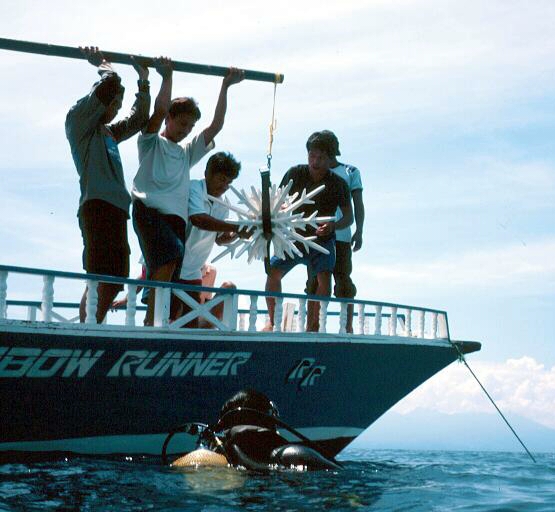
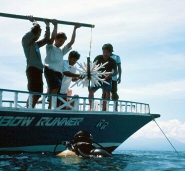
Lowering assembled modules into the water using a simple bamboo davit. Because EcoReefs® modules can be easily moved without using heavy lifting equipment, deployments can be done in remote sites with small boats.
© 2001 Michael D. Moore
|
|
John Kanteley using a lift bag to bring the modules to the site.
© 2001 Michael D. Moore
|
|
|
 |
|
 |
|
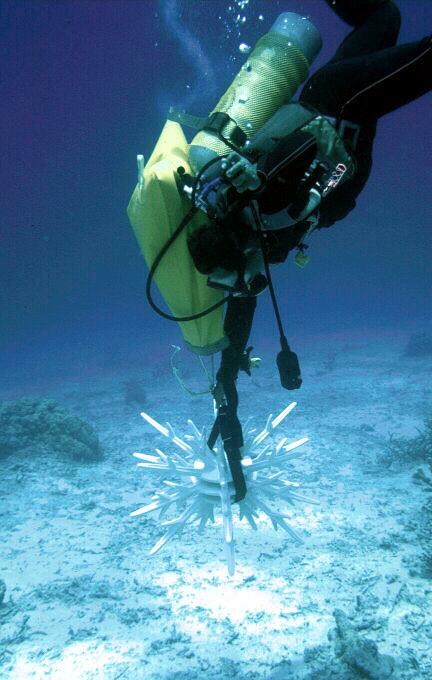
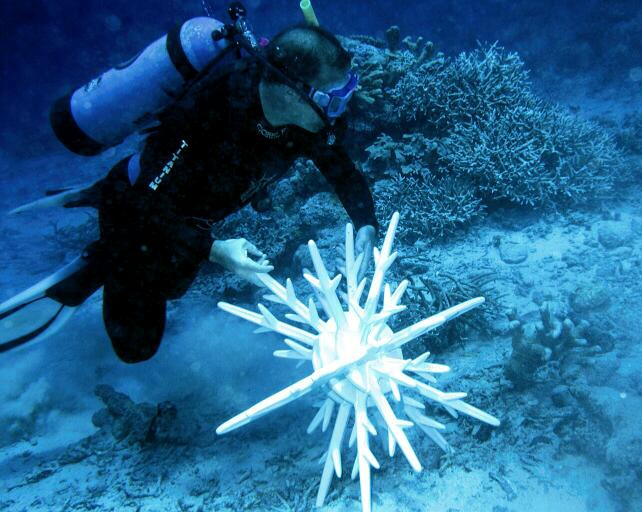
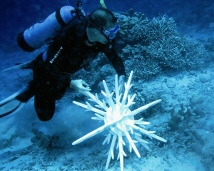
Dr. Michael Moore moving modules into position. Once in place, the modules were anchored to the reef slope using a 2m rebar stake passed through the center of each module. © 2001 Michael D. Moore
|
|
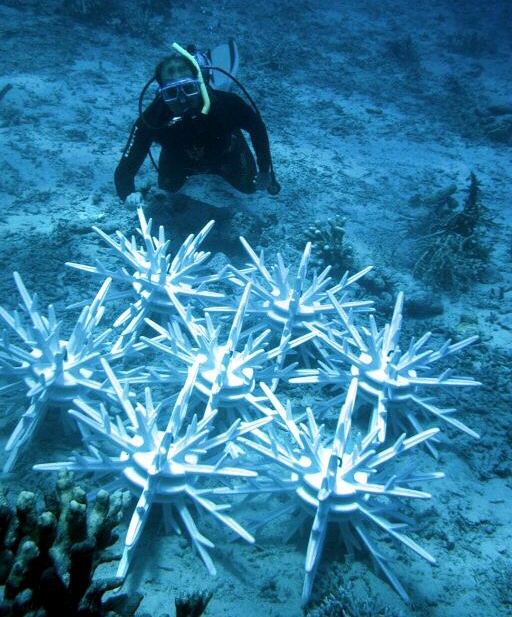
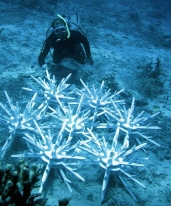
Top view showing anchored modules arranged in a close-packed hexagonal array. © 2001 Michael D. Moore
|
|
 |
|
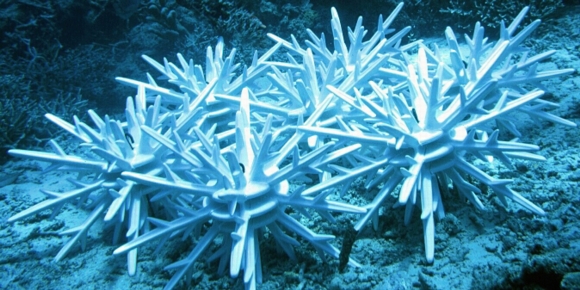
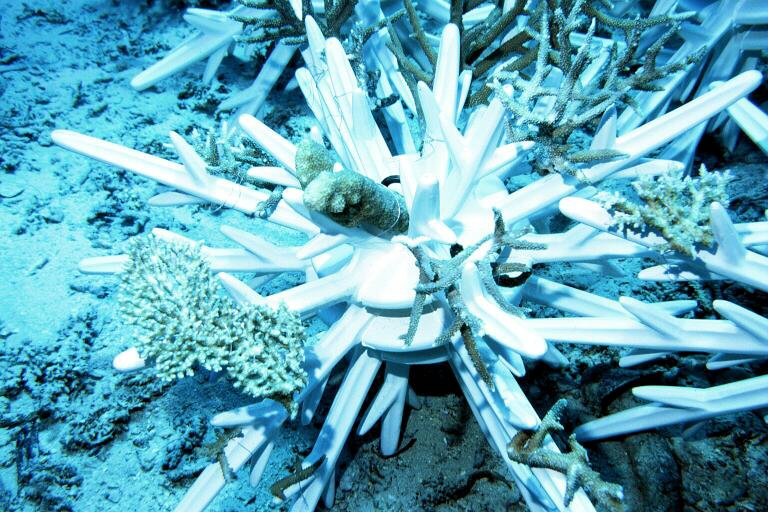
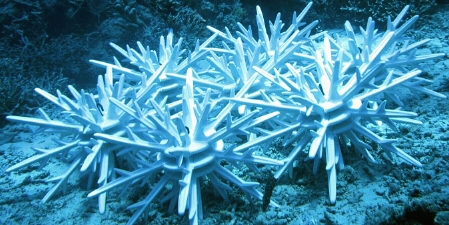
Completed EcoReefs® installation. The branches create a spatially complex habitat for fish while the shaded settling plates create an ideal microenvironment for coral recruitment.
© 2001 Michael D. Moore
|
|
|
 |
 |
|
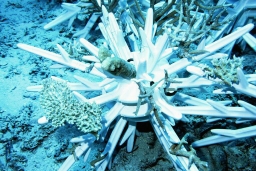
Five species of Acropora were wired to several of the modules to assess transplantation potential.
© 2001 Michael D. Moore
|
|
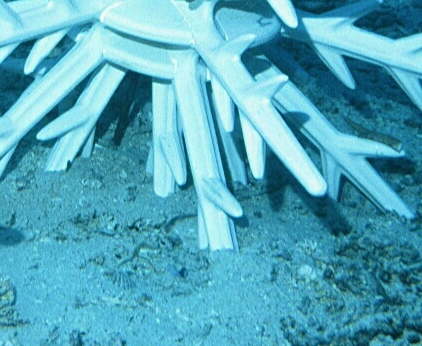
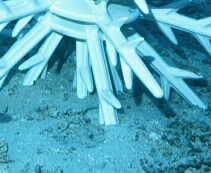
Close-up view of module base showing how the inner and outer branches provide support and stability in loose sediment.
© 2001 Michael D. Moore
|
|
|
|
|
Field Notes
|
|
|
|
Monitoring observations by Dr. Mark Erdmann.
- October 18, 2001.
EcoReefs demonstration installed.
- October 19, 2001. 24 hours.
Fish investigating structure. Bream, bicolor wrasse, squirrelfish, and butterflyfish seen on structure.
- November 7, 2001. 21 days.
The modules are completely covered in fine algae at this time, and fish have definitely decided they are okay. Plenty of damsels and gobies hanging out in between, and a few soldierfish, small grouper, butterflyfish and surgeons made their way in and out of the modules during the video time (and before/after). With the transplants, only one was dead, while the rest looked pretty good (unfortunately we have elevated sea surface temperatures right now and a possible bleaching event is imminent with corals all around Bunaken starting to show initiation signs). No visible attachment points to the modules yet, but coral tissue has started to grow over the wire and all transplants are firmly in position - so this is a good sign. Overall - looks great - Pretty much in line with what you would expect. And the modules are definitely accepted by the fish community.
- December 1, 2001. 44 days.
The EcoReef modules have a complete fouling community covering their surface and the local reef fish assemblage appears fully acclimatized to their presence. A "natural" density (judged against nearby Acropora thickets) of damselfish are sheltering in the modules, while both surgeonfish and parrotfish are continuously grazing the algae on the structures (grazing marks are evident over the entire installation). Two small grouper species have also taken up residence under the structures (Cephalopholis miniata and Anyperodon leucogrammicus). Perhaps most encouraging, 32 of the 34 transplanted coral nubbins are still alive and appear healthy; all of them show tissue overgrowth of the securing wires and are firmly cemented in place. 11 of the transplants show a small degree of bleaching - perhaps expected given the increasing signs of ambient bleaching on natural coral colonies around Bunaken Island.
- December 27, 2001. 70 days.
Very important changes to the fouling community. Most importantly, coralline algal colonies (circular, 1-5 mm diameter) are beginning to cover modules), as are small tufts of turf algae. Several forams were also seen on the modules, as were numerous small green tunicates (Atriolum robustum) and several vermetid worm colonies. Coral recruits were not yet evident; however, 7 of the transplanted coral fragments have now formed obvious attachment sites to the modules. Of the 34 transplants, 6 are now dead (up from 2 last check), though the remaining colonies appear to have regained more color since the last inspection (probably due to lowering water temperatures after the near-bleaching event here in November).
From a fish standpoint, no new developments were noted, though the local fish assemblage clearly seems to regard the EcoReef installation as a reef-like shelter.
|
|
|
|
|
|
|
|
|
|
|
|
|
|
|
|
|
|