Conventional Artificial Reefs: Poor Tools for Restoring Coral Reefs

What about conventional artificial reefs?

What do they actually accomplish in terms of coral reef remediation?

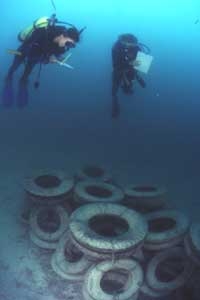
Conventional artificial reefs are typically made from ships, cars, tires, or variety of concrete forms. Although commonly installed in temperate waters to improve sportfishing and recreational diving, conventional artificial reefs are not appropriate for the remediation of damaged coral reefs for a variety of reasons:

  • Sinking of ships, cars, and concrete shapes on coral reefs structures the ecosystem without restoring living coral cover.

  • Materials like concrete and metal are chemically reactive in seawater and interfere with coral settlement and growth.

  • Shapes with large void spaces primarily function to aggregate adult fish, which can allow important brood stocks to be easily fished out.

  • Because conventional artificial reefs don't provide complex, fine-scale habitat for juvenile fish and herbivorous fish, they do little to restock depleted reef fisheries and often become covered with fast-growing algae that can smother and kill young corals.

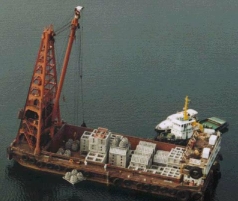
  • Expensive and cumbersome to install, conventional artificial reefs usually end up as small-scale, token deployments that fail to have any significant impact on fish and coral reproduction rates.

  • Designed to be indestructible, conventional artificial reefs often result in bizarre underwater eyesores of astonishing durability -- a poor choice for dive resorts and marine sanctuaries with excellent water visibility.

To many ecologists and conservationists, conventional artificial reefs represent a form of marine pollution with no ecological benefit.

To many divemasters and hotel owners, conventional artificial reefs are unattractive and a poor ecotourism investment.

Ships.

Tires.

Cars.

Concrete Blocks.

Heavy Lift Equipment.


EcoReefs Compared to Conventional Artificial Reefs

EcoReefs® beats conventional artificial reef solutions in comparisons of potential ecological benefits, impact on tourism, and ease and cost of deployment.

Feature EcoReefs® Conventional Artificial Reefs

Is it compatible with ecotourism?

YES: Looks Natural Underwater

NO: Unsightly Underwater

Does it remediate the reef ecosystem?

YES: Can Be Replaced by Living Coral

NO: Permanent Structure

Does it help build coastal fisheries?

YES: Provides Habitat for Juvenile Fish

NO: Provides Habitat for Adult Fish

Does it minimize algae growth?

YES: Provides Habitat for Small Herbivores

NO: Provides Habitat for Adult Fish

Does it promote coral growth?

YES: pH Neutral Surface Chemistry and Shaded Plates Ideal for Coral Settlement

NO: Concrete (basic pH) or Metal (reactive) Surfaces Retard Coral Settlement

Does it accept coral transplants?

YES: Coral branch tips can be attached directly to the module ceramic

NO: Additional surface preparation and mounting hardware required

Is it ecologically significant?

YES: Covers Large Areas

NO: Localized Effects Only

Is it fast & easy to install?

YES: Prefabricated, Ready for Use

NO: On-Site Concrete Pouring or Heavy Lifting Required

Is it cost effective?

YES: Mass Produced, Low Cost per Unit Area Covered

NO: Hand Built, High Cost per Unit Area Covered


return to EcoReefs® home

© 2001 EcoReefs®, USA. All rights reserved.
EcoReef® and EcoReefs® are registered trademarks.
This site is protected by copyright, trademark, and patent laws under U.S. and international law.
No part of this site may be reproduced without the express permission of
Michael D. Moore, Ph.D., President, EcoReefs®

Last Modified: Sunday, 09-Dec-2001 19:54:21 EST